


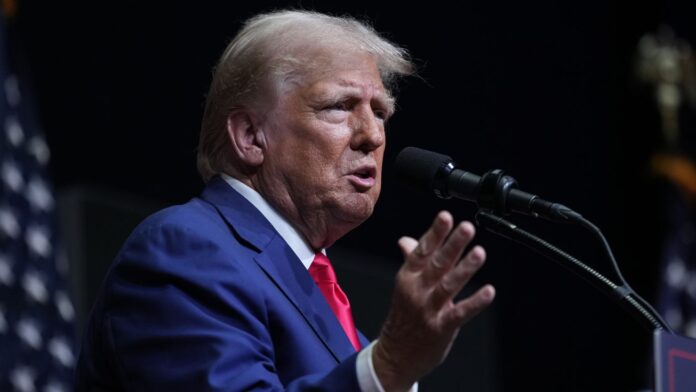

President Donald Trump has announced a temporary suspension of “Project Freedom,” a military initiative aimed at escorting ships through the critical Strait of Hormuz. He claims significant progress in negotiations with Iran could lead to a comprehensive peace agreement.
In a post on Truth Social, Trump stated, “Great progress has been made toward a complete and final agreement with representatives of Iran.” His announcement comes as the U.S. seeks to shift its approach amidst ongoing tensions in the Persian Gulf.
“Based on the request of Pakistan and other countries, and the tremendous military success we have had during our campaign against Iran, we have mutually agreed to pause Project Freedom,” Trump explained. The decision also coincides with the U.S. military’s commitment to keep the blockade in place, pending successful negotiations.
Launched only a day prior, Project Freedom intended to escort ships stranded in the Strait of Hormuz to safety. The operation began under the U.S. Central Command, following Trump’s announcement on Sunday. However, this initiative has led to escalated tensions in the region, pivotal for global oil transport.
The Strait of Hormuz sees nearly one-fifth of the world’s oil flow, and recent claims from the UAE reported attacks on its vessels by Iranian forces. The U.S. also announced the destruction of several Iranian boats involved in confrontations.
Trump’s remarks reflected growing optimism about a potential resolution to the conflict. Just hours before, U.S. Secretary of State Marco Rubio confirmed the conclusion of Operation Epic Fury, a military campaign initiated on February 28 to address security issues in the region, stating that operational objectives had been met.
“Operation Epic Fury is concluded. We achieved the objectives of that operation. We’re not cheering for an additional situation to occur. We would prefer the path of peace,” Rubio noted at a press conference on Tuesday. This sentiment aligns with Trump’s recent strategy focusing on diplomatic resolutions.
Regarding Project Freedom, Rubio clarified its primary goal was humanitarian, aimed at rescuing nearly 23,000 civilians from 87 countries trapped in the Persian Gulf due to Iranian aggression. “This is not an offensive operation. This is a defensive operation,” Rubio emphasized, highlighting that the military stance is purely protective unless provoked.
The military’s dual focus on defense and negotiation reflects a nuanced approach in an increasingly volatile situation. As the negotiations with Iran continue, observers worldwide will be watching closely to see whether diplomatic efforts will lead to lasting peace in the region.